American Time
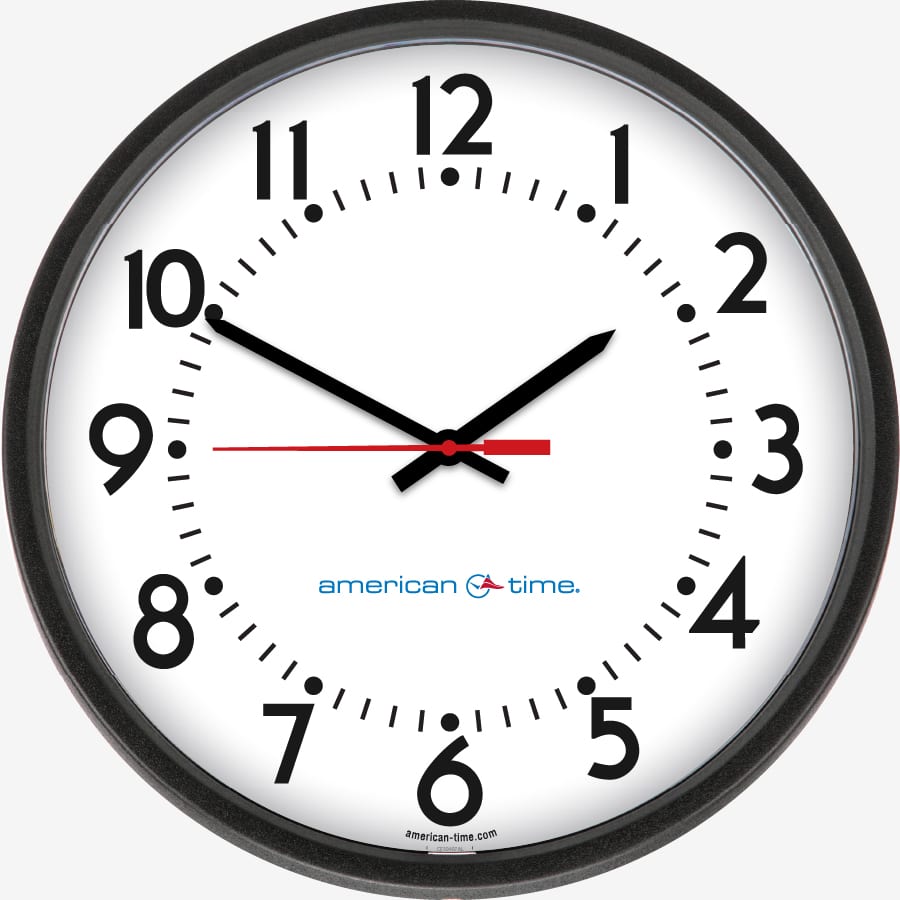
American Time AllSync Plus 12-inch 24V Surface Clock
Wired synchronized movement · 12 inches · 24V
A school hallway clock should be readable while students move, accurate across buildings, and durable enough for busy traffic, cleaning, and changing light.
Quick answer
Use reliable quartz for a single hallway; choose synchronized clocks for campuses where bell schedules, class changes, and emergency coordination depend on consistent time.
Field option
Source and product details are checked against the linked product page. Availability and price can change.
American Time
Wired synchronized movement · 12 inches · 24V
The best school hallway clock is readable while people are moving, accurate enough to agree with the bell schedule, and durable enough for a high-traffic building. A single hallway may only need a reliable quartz clock. A campus with multiple wings or buildings benefits more from synchronized time.
Hallway clocks do more than tell students when class starts. They provide a common reference during passing periods, testing, assemblies, deliveries, and emergency coordination. A clock that is five minutes slow can create repeated confusion across an entire day.
Test the clock from the far end of the hall while walking, not standing directly beneath it. Students should be able to identify the time without stopping in the traffic flow. Strong contrast and clear numerals matter more than decorative styling.
| Hallway Condition | Weak Clock Behavior | Better Signal |
|---|---|---|
| Long corridor | Small face disappears | Larger face with bold marks |
| Passing periods | Clock is hidden by people | Elevated, unobstructed placement |
| Fluorescent lighting | Glossy face reflects fixtures | Matte cover and contrast |
| Multiple buildings | Each clock drifts differently | Synchronized time source |
| Daily cleaning | Delicate case or hard access | Durable, wipeable housing |
The clock should be readable without encouraging students to stop in the middle of the hallway.
Quartz is a practical choice for one low-risk hallway if staff can check and correct it. The important requirement is not theoretical precision but agreement with the schedule people actually follow.
Synchronized clocks become valuable when a school has many halls, floors, or buildings. Network, atomic, or centralized systems can reduce the maintenance burden and prevent one room from showing a different time than another. Choose the source that the facilities team can reliably support.
Do not install synchronized hardware without planning for signal coverage, power interruptions, and correction procedures. A simple system that staff understand is better than a complex system that nobody maintains.
Mount the clock where it is visible over normal foot traffic but not directly above a doorway, stair landing, or location where a loose object could create a hazard. Keep it away from bright windows and digital signage that competes for attention.
A hallway clock should not be hidden behind banners, seasonal displays, or temporary announcements. Leave enough clearance for cleaning and maintenance, especially in buildings where lifts or access equipment require advance scheduling.
Analog clocks remain easy to integrate into a school hallway and provide a calm visual reference. Use a silent movement if classrooms or testing rooms are nearby. Digital clocks are helpful when exact minutes are central, but keep brightness controlled and avoid scrolling messages unless the display has a separate communications purpose.
| Clock Type | Best For | Skip If |
|---|---|---|
| Large quartz analog clock | One hallway or small school | Many buildings need identical time |
| Synchronized analog clock | Multi-wing campuses | Facilities cannot support the time source |
| Digital wall clock | Labs, gyms, and exact schedule zones | The display is too bright |
| Small classroom clock | Individual rooms | Students must read it while walking |
Choose a hallway clock from the moving student’s viewpoint. Make it clear, high enough to remain visible, and easy for facilities staff to maintain. Use synchronized time when the school truly needs campus-wide consistency, not simply because the feature sounds advanced.
Related reading
Meeting Room
Atomic clocks reduce time drift automatically, while quartz clocks are simpler and quieter to own when perfect synchronization is not required.
Meeting Room
A shared, high-visibility countdown timer turns the wall into a neutral arbiter that keeps boardrooms and workshops on schedule.
Meeting Room
A productivity wall clock must be readable across a room, free of distracting features, and precise enough to end debates about time.